
How to Find Working Coupon Codes & Promo Codes Online: The Complete Guide
Learn how to find working coupon codes online. Discover where promo codes come from, how to bypass expired scraper links, and how to verify checkout discount terms.

Almost every online shopper knows the exact moment of checkout friction: you add items to your shopping cart, click proceed to checkout, and are confronted by an empty input field labeled "Enter Promo Code" or "Apply Coupon."
Instinctively, you open a new browser tab and search [Brand Name] + coupon code. What follows is an exercise in frustration. You click through five different coupon aggregator sites, copy six different codes labeled "80% OFF SITEWIDE," and paste each one into the checkout box—only to watch the cart return a string of red error messages: "Code invalid," "Coupon expired," or "Terms not met."
Why does this happen so consistently? And how can you reliably find discount codes that actually work?
In this comprehensive guide, we demystify the mechanics of online coupon codes. You will learn where legitimate discount codes originate, how to bypass auto-generated scraper junk, how to decode checkout fine print, and how to use transparent verification tools like OffersNudge to secure real savings in seconds.
1. Where Coupon Codes Actually Come From
Coupon codes do not materialize out of thin air. Merchants issue promotional codes deliberately to achieve specific commercial objectives: acquiring new customers, lifting average order value (AOV), clearing seasonal inventory, or tracking marketing campaign performance.
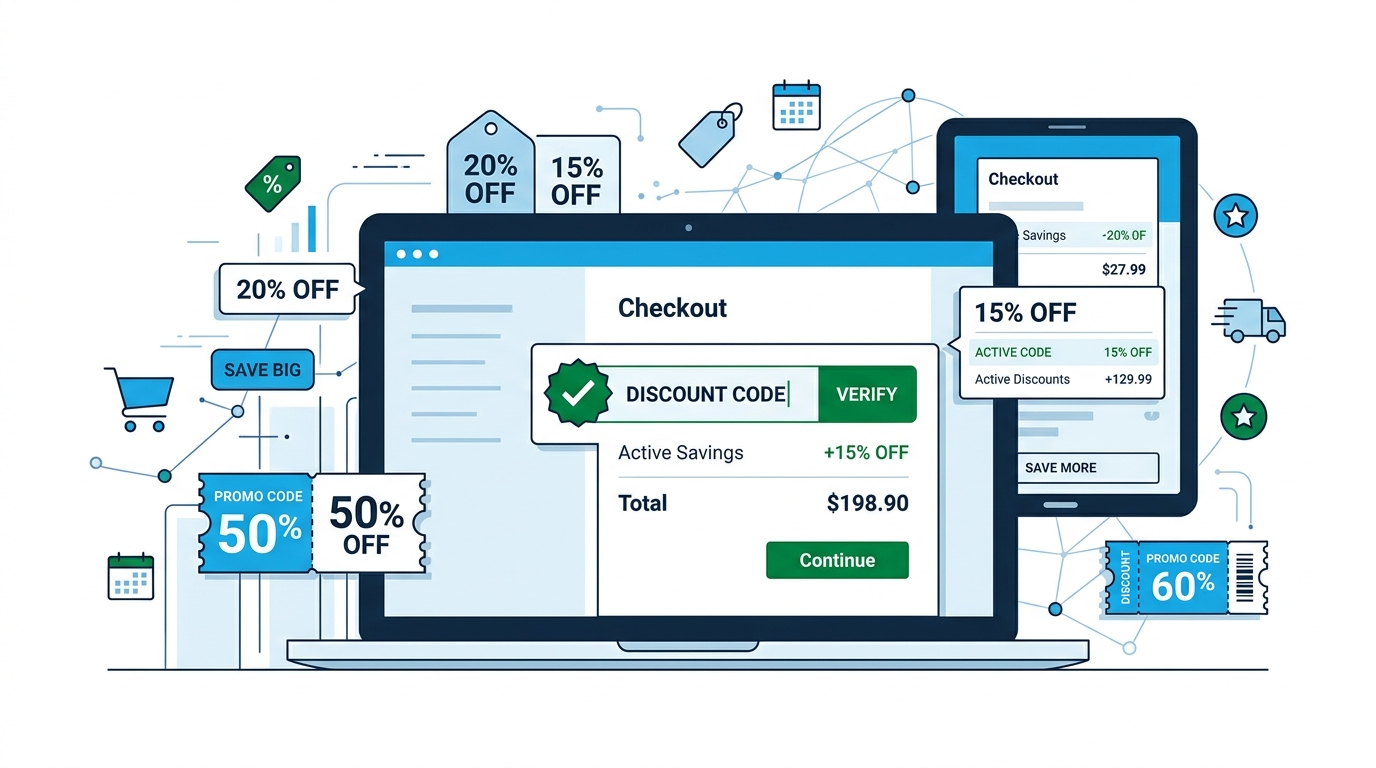
Legitimate coupon codes originate from five primary distribution channels:
| Channel | Typical Code Format | Why Merchants Issue Them |
|---|---|---|
| Affiliate Networks | WELCOME18, GET50 |
Incentivizes publishers to feature merchant offers |
| Creator Partnerships | PODCAST20, ALEX15 |
Tracks specific influencer audience conversions |
| Email Welcome Flows | WELCOME-7X9B2 |
Captures customer contact details before purchase |
| Cart Abandonment | COMEBACK10 |
Recovers hesitant buyers prior to cart exit |
| Seasonal Campaigns | SUMMER2026, BFCM |
Timed revenue acceleration during retail windows |
A. Affiliate & Publisher Networks
Merchants partner with affiliate networks (such as CJ Affiliate, ShareASale, Admitad, or Cuelinks) to distribute trackable promotional codes. In exchange for publishers driving qualified buyers, the merchant provides exclusive or semi-exclusive discounts. For example, Hostinger provides verified partner codes like WELCOME18 (view the verified Hostinger coupon on OffersNudge) to grant shoppers a flat 20% discount while tracking publisher attribution.
B. Creator, Influencer, and Podcast Sponsorships
Brands frequently allocate custom codes to creators (e.g., CREATOR20 or YOUTUBE15). These codes typically offer fixed percentage savings and allow the brand to measure the direct return on investment (ROI) of a specific sponsorship channel.
C. Direct-to-Consumer Email & SMS Welcome Journeys
When you visit a merchant for the first time and see a pop-up offering "10% off your first order," the brand is offering a financial trade: a discount in exchange for your zero-party data (your email address or phone number). These codes are often single-use dynamic hashes generated exclusively for your inbox.
D. Cart Abandonment Sequences
If you create an account, add products to your cart, reach the shipping step, and then close your browser tab, automated marketing engines (like Klaviyo or Omnisend) will often trigger an abandoned-cart email 6 to 24 hours later. These emails frequently include an incentive code (e.g., "Still thinking it over? Take an extra 10% off with code FINISH10").
E. Seasonal & Inventory Clearing Campaigns
During cyclical retail windows (Black Friday, Cyber Monday, End-of-Financial-Year, or seasonal clearance), brands launch broad, public promotional campaigns to hit quarterly volume targets.
2. How to Find Legitimate, Working Codes (Systematic Search Tactics)
Instead of clicking randomly on low-quality search results, use these systematic search methods to uncover active codes:
A. Precision Search Operators
When searching for promo codes on Google, broad searches yield automated scraper pages. Use search operators to filter for recent, indexable merchant-issued codes:
"[Brand Name]" "coupon code" OR "promo code" -site:pinterest.com"[Brand Name]" "discount code" "2026"site:[merchantwebsite.com] "coupon" OR "promo"
B. Inspect Merchant Newsletter Archives and Banners
Before turning to third-party sites, check the merchant's own ecosystem:
- Scan the top notification banner across their homepage and category pages.
- Check their official social media profiles (particularly X/Twitter and Instagram), where marketing teams often post flash promotional codes for product launches or holiday weekends.
- Review their dedicated deals or clearance page (often located at
/sale,/deals, or/special-offers).
C. Check Curated Verification Platforms
Rather than visiting scrapers that boast "5,000 active codes for every store," use dedicated deal discovery platforms like OffersNudge. Platforms that focus on curated, active merchant inventories—such as verified software discounts on InboxKit or hosting deals on Hostinger—manually verify code validity so you avoid broken checkout attempts.
3. Why Most Online Coupon Codes Fail (And How to Spot Expired Ones)
The reason 90% of codes found on generic coupon portals fail comes down to the business model of programmatic coupon scraping:
- Automated bots crawl the web and scrape every sequence of capital letters that looks like a coupon code.
- The aggregator creates thousands of auto-generated URLs (e.g.,
[brand]-coupons-2026). - These sites intentionally leave expired codes live because expired listings still generate organic search traffic from search engines.
- When a shopper clicks "Show Code," the site drops an affiliate tracking cookie and reveals a dead code. The site collects traffic, but the shopper leaves empty-handed.
How to Spot an Expired or Fake Code in 5 Seconds:
- Missing Verification Timestamps: If a coupon listing does not display an exact date when the code was last tested, assume it is inactive. On OffersNudge, every verified offer displays a visible verification badge (e.g.,
Verified 9/21/2026). - Absurd Percentage Claims: If a luxury brand, Apple product, or enterprise software tool is listed as "90% off sitewide with code," it is virtually guaranteed to be a fabricated or misattributed code.
- Generic Letter Strings: Codes like
SAVE,DISCOUNT, orOFFERthat lack merchant context are often algorithmic guesses that never existed in the merchant's checkout database.
4. Decoding Exclusions, Minimum Spends, and Fine Print
Even a 100% legitimate, active coupon code will fail if your cart violates the merchant's promotion terms. When a code returns an error, check these four common restrictions:
- Category and Brand Exclusions: Merchants frequently exclude low-margin products, newly launched items, gift cards, or third-party vendor products from sitewide promotions.
- Minimum Spend Thresholds: Many codes require a minimum qualifying cart value (e.g., "$20 off orders over $100"). Crucially, taxes, shipping charges, and discounted clearance items are typically excluded when calculating the qualifying subtotal.
- New Customer Restrictions: Welcome discounts and first-order promotions (like sign-up bonuses) are hardcoded to apply only to accounts with zero previous order history. If your email address or billing profile exists in the merchant's customer database, the checkout engine will reject the code.
- Non-Combinable / Non-Stacking Clauses: If items in your cart are already marked down on sale, many merchant engines will refuse additional promo codes under a "cannot be combined with other offers" rule.
5. How First-Order Discounts Work (And How to Claim Them)
First-order discounts represent some of the highest percentage reductions available in e-commerce, frequently offering 10% to 20% off.
How to Ensure Your First-Order Discount Applies:
- Register Before Checking Out: Create your account and confirm your email address before assembling your cart. Some checkout platforms fail to apply welcome codes when shoppers check out as a guest.
- Watch for Verification Delays: Many merchants send welcome promo codes via automated email rather than displaying them instantly on-screen. Check your spam and promotional tabs if the email does not arrive within two minutes.
- Single-Use Hashing: Modern first-order discounts are tied to your specific email address. Copying a welcome code from a friend will fail if the checkout email does not match the recipient email.
6. Navigating Renewal Discounts (SaaS, Software & Hosting)
In subscription industries—particularly web hosting, cloud storage, and SaaS applications—discounts operate on a different financial model than retail e-commerce.
Merchants offer steep introductory discounts to offset customer acquisition costs (CAC). For example, SaaS video creation platform FlikiAi offers 40% off annual subscriptions to encourage long-term user onboarding. However, once the initial promotional period ends, the subscription renews at standard list rates.
How to Manage Renewal Pricing:
- Calendar the Renewal Date: The moment you purchase a discounted annual software or hosting package, set a calendar notification 30 days prior to renewal.
- Initiate a Support Inquiry: Contact customer success or billing support before the renewal invoice processes. Inquire about loyalty discounts or annual renewal incentives. Because retaining an existing user is far cheaper than acquiring a new one, software providers frequently have retention concessions available.
7. Student, Educator, and Professional Discounts
If you are a student, educator, healthcare worker, or military veteran, you often have access to standing 10% to 30% discounts that do not expire like standard seasonal coupon codes.
Modern merchants verify these credentials through identity networks:
- UNiDAYS & Student Beans: Common for consumer lifestyle, fashion, electronics, and streaming platforms.
- SheerID: Used extensively by software vendors, airline travel programs, and enterprise tech brands.
- GitHub Student Developer Pack: Provides thousands of dollars in free and discounted developer software, cloud hosting credits, and API access for verified students.
8. Annual-Plan Discounts vs. Promo Codes
One of the most reliable ways to secure a discount on recurring software or web services is to leverage built-in annual billing structures.
Most SaaS and hosting providers discount their annual packages by 15% to 40% compared to rolling monthly billing. In many cases, you can combine this structural discount with a verified promo code. For example, applying a flat 20% coupon code like Hostinger's WELCOME18 on a multi-year term stacks your savings, reducing your effective monthly hosting cost to a fraction of standard pricing.
9. Store-Specific Promotional Codes
Promo codes generally fall into two technical categories:
- Public Merchant Codes: Broad promotional codes published directly on the merchant's site or in marketing newsletters (e.g.,
FALL20,FREESHIP). These can be used by any eligible shopper until the promotion expiration date. - Dynamic / Unique Codes: Generated algorithmically for a single transaction (e.g.,
WELCOME-9A82-KL12). Once redeemed at checkout, the merchant's database marks the unique key as used, rendering it invalid for any other user.
Understanding this distinction saves time: if a coupon site displays a long, randomized string of characters as a "sitewide code for all users," it is almost certainly a spent, single-use code that will fail.
10. How to Objectively Compare Multiple Offers
When multiple promotions are available, calculate the net mathematical savings rather than assuming a percentage discount is always superior:
| Offer Type | When It Delivers Maximum Value | Watch Out For |
|---|---|---|
| Percentage Off (e.g., 20%–50% Off) | High-value carts and annual software tiers (e.g., InboxKit 50% Off Azure Domains) | Maximum discount caps (e.g., "20% off up to $50") |
| Flat Value Off (e.g., $20 Off) | Smaller orders near the minimum spend threshold | High qualifying spend requirements |
| Free Shipping / Free Add-On | Heavy physical goods or infrastructure add-ons | Minimum cart thresholds that force unnecessary purchases |
11. How OffersNudge Helps You Find Verified Codes Without the Guesswork
At OffersNudge, our entire platform architecture was designed to eliminate the frustration of dead, recycled coupon codes.
Our Verification Principles:
- Manual Testing & Freshness Audits: We regularly test promotional codes and deal links on active checkout carts. When a code stops working, we retire it rather than leaving dead listings live for vanity traffic.
- Transparent Verification Dates: Every active offer on OffersNudge displays its verified date so you know exactly when the code was last confirmed.
- Direct Access to Category Hubs: Whether you need sales infrastructure tools in our SaaS category, reliable web infrastructure in our Hosting category, or e-commerce deals in our Stores directory, offers are categorized logically for fast discovery.
- Community Submissions: When shoppers uncover unlisted promotional codes, they can submit them directly through our Coupon Submission Portal for editorial verification.
12. Frequently Asked Questions
Why do coupon codes work on coupon websites but fail at checkout?
Most generic coupon websites scrape expired codes from the web and leave them online indefinitely to attract search traffic. When you paste the code at checkout, the merchant's database rejects it because the promotion has concluded, the redemption quota has been met, or your cart does not meet the qualifying product conditions.
Is it safe to use coupon browser extensions?
Reputable coupon browser extensions are generally safe, but they operate by injecting affiliate tracking cookies into your browsing session and monitoring your cart contents. If you prefer not to share your browsing telemetry with third-party extensions, checking dedicated deal verification hubs like OffersNudge before checking out provides the same savings without background browser tracking.
Can I reuse a single-use welcome promo code?
No. Single-use welcome codes are tied to individual email addresses and marked as redeemed in the merchant's order database the moment your transaction completes. Attempting to use the same code a second time will trigger an "already used" error.
What is the difference between a deal and a coupon code?
A coupon code requires copying a specific alphanumeric string and pasting it into an input field at checkout to apply a discount. A deal (or automatic discount) applies the promotional pricing automatically via a specialized tracking link or landing page without requiring manual code entry.
13. Transparency & Affiliate Disclosure
OffersNudge is supported by affiliate partnerships. When you browse our verified deals, copy a coupon code, and make a purchase, we may earn an affiliate commission from the merchant at no additional cost to you. This compensation enables our team to audit deals, maintain verification databases, and build educational buying guides. However, merchant terms, coupon availability, and pricing remain under the sole control of the respective retailers. Always review your final checkout total before submitting payment. Read our full Affiliate Disclosure for more information.